The invisible veil of unspoken social barriers, presumptions, stigma and taboo is what shrouds those of us who have a visible difference or additional needs. These barriers are projected by, and often shield us from, the majority adult population, thus marginalising an entire section of society.
The majority of people often look upon those with additional needs as asexual – unaware of their own biological changes, nevermind acknowledging the same desires as everyone else. According to frank interviews and research for this piece, what was unearthed was the glaringly obvious truth.
It takes being considered as social material before one can get beyond first base in the big game of life. An interviewee who wished to remain anonymous stated how, as a visually impaired person, it’s almost impossible to make meaningful social connections in crowded or unfamiliar places because you are left waiting for someone to approach you, as the all-prevailing lack of eye contact seemingly rules in the watch-and-wait, look-and-smile category. On the flip side, people with no additional needs might lack the confidence or inclination to approach someone with a visible difference they have never experienced. It was also pointed out that if one finds it hard to get from A to B, then just getting out to socialise, let alone anything else, can render someone socially isolated.
The barriers faced by people with additional needs are constant and can vary depending on the nature of someone’s circumstances, so the natural desire to be socially included, liked or loved is often seen as secondary to someone’s supposed primary needs being fulfilled. A woman with additional needs on her own might face the double stigma of ‘what’s she doing here’ or ‘need any help, love?’ rather than a classic chat-up exercise. Any interaction is often functional, rather than social.Adolf D. Ratzka of the Independent Living Institute in Sweden forthrightly stresses that because people with additional needs are routinely portrayed as “objects of care or sick, how could they possibly be viewed as sexy?”
Marilyn M. Irwin of Indiana University rightly asserts how sex is still a taboo within society and often spoken in hush-hush circles. She says, “Add disability to the equation and myths about people with disabilities and sex abound. It is assumed people either aren’t interested or capable.”
It all starts with education – at home or school. Cultural blueprints may dictate whether or not sex will be discussed openly in the home, regardless of whether a child has additional needs or not. Young people still find out in the playground if a school only furnishes the reproductive facts. At specialist schools, societal assumptions and presumptions are mirrored both through parent’s increased anxieties and the school’s approach. Another interviewee pointed out that the approach of specialist schools is patchy at best in the sex ed department.
Sharon Rhodes, Pathway Leader for Life Skills at Communication Specialist College in Doncaster, explained that sex ed is not a straight-forward curriculum and widely varies according to a learner’s individual needs and level of understanding. Despite policies and the media opening up, Ms Rhodes points out the fact that “outside the college environment, the notion of young people as sexual beings is still viewed as disdainful. Parents often adopt the view that their youth are still small children needing to be taken care of, not real people with real needs.” The college will provide practical guidance for potentially sexually active couples, yet many specialist education providers have no sex ed programme at all, thus bypassing the issue.
With internalised oppression so deeply ingrained in our pecking order, perpetuating those with additional needs as the weakest in society, for those of us craving greater social and sexual inclusion it drowns out any calls for dignity, equality or acceptance as capable potential relationship material. It makes the job of levelling the playing field an uphill climb.
In short, with increased integration in schools and other areas of communities, things are changing, yet possibly too slowly for people’s immediate sexual needs.
Ratzka illustrated how people with physical difficulties often engage with sex workers for their relief: a mutually understood exchange between demonised individuals.
However, small initiatives at local level, such as supported nightclubs are making a difference.
I’m always astounded when I hear of the likes of Fleetwood Mac’s Christine McVie, Pink Floyd’s Roger Waters and others out there still touring, traipsing the world and playing their hearts out while pushing their seventh decade.
I just saw Courtney Love live on her UK tour; still ronching and shouting out that timeless passion and rage – pushing fifty…
My point is, at fourty-something, I still want to make a lifelong dream a reality and sing, write songs and perform them.
So, I recently not only put out ads and pounded some of Sheffield’s streets to pen ads on notice boards, I answered an ad – both came to nothing.
Of course the landscape of popular music is typically and tradditionally dominated by twenty-something-year-olds; male and, yep I’m gonna say it, clinging onto cool like a life raft!
So the lads I responded to sent me clips of their punky stuff – it was fine, but after they had described themselves as ‘all between twenty-four and twenty-six, I thought “hmmm, not sure”.
All I said in reply was: I’m slightly wary of my age, which maybe I shouldn’t have said, not actually revealing my age, but the result was: ‘we don’t think it would fit with us, thanks for your interest’.
Okay, so I’m a “late bloomer” and no, don’t really want to tag onto kids where I’m old enough to be their mum, but should age be the ultimate defining factor in considering the dynamics of a band?
I think not!
Of course we all need to creatively connect with like minds and commonalities.
Yes, I wanna sing about the constant barriers I face, loneliness, political decay and life experiences.
While I’m not held down by marriage, mortgage and keeping up with the Jones’ – I still have a life and want to keep it more colourful and vibrant than my eyes can see…
I won’t be adopting a folky, gently gently, guitar strum strum strummy persona with a flowing skirt; the caricature often taken on by more mature female singers. I won’t be blagging it with the mindless/shallow rinky dinky winky the younger girls seem to be happy with in what is so flippantly dubbed pop.
Nope, I’m a die hard, set in my ways and opinions; yet could diversify and cross genres.
I just wanna sing, rock and write the truth.
I have all the pent up passion and rage, moody melancholy and zeal that the big well-known die-hards possess.
Anyone care to join me? HAHAHA – I won’t hold my breath.
I still need a drummer, base and guitar – preferably mature (that could even mean mature-minded) with some commitment, willing to work, real and ready to rock.
On 25th of January in Greece, Syriza, a left-wing party, won the election – igniting widespread reaction, particularly on the left in the UK.
Background and austerity
Forming in 2004, Syriza evolved from a collection of left-wing groups upon the fall of Communism in 1989.
On a Socialist platform, they have challenged harsh austerity measures set out by the European Union and trans-national financial institutions.
Linda Duckenfield, sixty-seven, retired community education worker and Green Party parliamentary candidate for Sheffield southeast, said:” It was ‘smoke and mirrors’.
Even in 2007 austerity was a smokescreen devised by the capitalist speculators within the banking crisis on the money markets.” In reaction to the Greek election, she said: “It meant finally, a party could get passed the language of austerity and that’s what happened.”
The UK Left
Historically, the UK left has encountered huge challenges.
Similar to Syriza, the left comes with internal differences in tactics and a contrasting revolutionary versus transitional approach.
The four main Socialist parties in the UK are: the Socialist Party (SP, formerly militant, established in 1991) the Socialist Worker’s Party (SWP, formed in the 1950s as a revolutionary group) the Green Party (originally the Ecology Party) and the Communist Party of Britain (formed in 1920 from a collective of Marxist organisations).
These parties mentioned were born out of frustration with Labour, which is widely recognised as disassociating itself with the union movement it came out of – adopting a more right-wing model.
Thatcherism, which introduced some of the toughest anti-union laws, the defeat of the minor’s strike and recent youth riots in 2011; are just some of the setbacks endured by the British working-class.
Alistair Tice, organiser for the Socialist Party in Sheffield, said: “despite the student’s, TUC and pensions demonstrations, within days of the heightened mood the right-wing moderate trade union leaders, sold out on the pensions deal; thus leading to disempowering the electorate once again.”
The upshot of collective struggle and need for a new worker’s alternative, was the forming of the Trade Union Socialist Coalition (TUSC) in 2011.
Initiated by the Railway Maritime Transport (RMT) union, so far TUSC is made up of the RMT, the SP, SWP and a handful of breakaway Labour counsellors.
Unfortunately, TUSC has not yet secured full backing from the unions, a vital political/financial ingredient.
Despite this, Mr. Tice has pointed out how TUSC has stood 560 council candidates nationally; in last May’s local elections, quadrupling previous years.
He said: “With these significant gains, it does not mean TUSC will be in power, but it shows the need for an alternative, as well as how quickly things can change.”
He cited how in 2009, Syriza won less than 5% of the vote, clenching a victory within 6 years.
With our general election looming, in Sheffield alone, TUSC has parliamentary candidates standing in all the parties highlighted, including the Greens; standing candidates for all of the twenty-eight wards, a true reflection of discontent with the main parties.
Mr. Tice stressed the need for councils to challenge austerity.
Sheffield has experienced some of the worst austerity as the gap between the fortunate and impoverished has widened in the last eight years, according to a Sheffield University study.
However, David Blunkett, Labour MP for Sheffield’s Hillsborough and Brightside, said the UK economy was picking up – being partially redeemed through the banking sector; thus off-setting some austerity measures.
By contrast, facing extreme austerity, Greece’s Syriza has opened the flood gates for change.
Jay Williams, district coordinator for the SWP, said: “I think that Syriza represents the politics of hope…”
Being of a Pagan persuasion, I believe our life on this earth has evolved from a previous journey and will evolve to another journey when our life is finished here.
My journey in this life began on the 18th of March 1967 in Laguna Beach California.
I was born to a father who rejected me and didn’t want to know anything of my mother, so would grow up with a single mother of four other sisters.
From the beginning, my childhood was tough, lonely and blighted with being severely visually impaired and all of the struggles it came with.
I struck out on my own at seventeen – leaving a dysfunctional and volatile family life behind me.
Yet, having to be self-reliant and resourceful all my life, I adapted well to the responsibilities and challenges of adult life on my own.
At nineteen I went back to California, after having been schooled in my adoptive step dad’s native Texas.
I got jobs, shared apartments and maintained loose contact with family – keeping my mother at arm’s length.
After landing a good job doing data entry for Recycler Publications, a free-ads paper for people selling anything from antique collectables to cars, I made contacts, in the form of pen pals, via the sister paper, Loot in London, UK.
Any social life I might have had at the time was fragmented, but I met an English guy at a house party one night.
Martin from Portsmouth, a dark wavy-haired charm of a guy, gave me just enough attention that I sought him out, but as was my usual misfortune with men; he ‘really didn’t want to know’.
What he had told me though, planted a seed he’ll never know was planted.
He told me how, he would work enough to travel, work some more at whatever job he could, then travel back to England to save up more to travel again.
His adventurous spirit awoke in me, my own lust for adventure; a part of myself I never knew existed.
So, any lusting I had for Martin was forgotten as I pursued travelling to the UK, where I had read Harlequin novels in braille as a teenager and only imagined getting out of a place I never felt a part of.
Journey to a new life
When I came to the UK the first time, it was for a long two-month holiday and I was able to take up the newspaper job when I went back.
In coming the second time though, I had planned to stay for good and never looked back!
The first time, I had met the pen pals I had regular contact with and the ones who sounded the most sane.
I didn’t plan a thing and was very much the awkward American, who spoke too blunt/honestly and lacked the art of British subtlety.
Yet at the same time, somehow I had been before.
At the time I didn’t know when or why – it wasn’t just that I had read about it – I had been here before.
When I went back, all I could think of, was being in England, a pub on every corner, the contrast between regions, as I had spent time in London, Liverpool and Manchester during my holiday.
I was flabbergasted at the diversity of people and vibrancy of places – places which were old and steeped in history and character.
Nothing was the same for me and, I just had to get back.
When I returned the second time, I knew I was coming home. I had sold all of my furniture, quit my job at the Recycler and scraped all my savings and income tax return.
I had secured a 6-month work visa via BUNAC (a work abroad/exchange programme) and that was it; nothing was stopping me.
When I went back after the first time, California and everything I knew, hadn’t moved and seemed so predictable, colourless and steeped in convention; what the hell did I have to lose? – I certainly had everything to gain.
Little did I know, what I would gain is uncharted prejudices, a ‘cannot do’ blanket of cloud and a new life of fresh hell.
London life was dogma and full of twists and turns.
I met interesting people, but all the sudden my identity was in question. I had never been called ‘disabled’ or seemingly evoke repelling reactions from people to my visual impairment.
I was refused jobs with the patronising: “how will you make the stairs love?”
Looking for a room to rent, I would travel across London on a transport system completely foreign to me, yet liberating, just to get: “Uh, no, it’s not here, it’s taken…”
The spinster-type middle-aged woman at the YWCA hostel I stayed at in central London during my job hunt, sparked a hostile reaction to me, citing – they weren’t ‘warned’.
I had never experienced so much discrimination and adverse reaction.
I constantly heard: “Are you alright?” while walking downs a street, so I thought, shit! Do I have a wart on my forehead or what???
The years paraded past, yielding further sensory loss, one emotional upset after another. There was no ‘big adventure’ in my new life – it had just become this game of win or lose, prove myself or be disproven – try, or weather the trial…
In the midst of it all, I had met an expat who gave me some tips on legalising – so, I followed them, pretty much down to the letter. Yet, it would be three years and a relentless game of cat-and-mouse with immigration, becoming homeless, suffering a miscarriage through an abusive relationship and eventually becoming pregnant with my only son and soulmate, before the next phase.
My journey with Jasper
Coming off benefits and becoming homeless was such a senseless sacrifice. The cat-and-mouse game with immigration wasn’t going well and becoming homeless meant squatting in North London and selling the Big Issue street paper.
I was desperate though, to this day I could never put into a coherent explanation, but I just ‘had to’ get what I wanted – British residency, despite the damning discrimination and, eventually, to spite my bloody sanity…
I had gone from selling the Issue to begging for beer money down along Camden canal – on the way to my favourite biker pub.
There was a one-night stand that would change my life forever, an unwanted encounter with a platonic friend, then the suicide attempt.
The blatant discrimination for such a crap job, was just too much to bear and the last straw…
Then it happened; I found out I was pregnant during a computer course and the post trauma of being suicidal and hospitalised; it was from that one nighter with the guy in the Holey Arms (biker pub).
It took a month to trace him, but I found him – the intelligent yet arrogant guy I had met.
He knew what I had to say and, he insisted I say it in front of his dopey mate outside a gay pub in Camden Town.
Just before going to live in Brighton, to escape the noose closing in on me in London, I felt him kick.
I first stayed with some friends of Matt’s (my baby’s father) then, I was nearly eight months pregnant before being rehoused in a grotty studio flat in Brighton’s North Lanes.
Then he came to me, at 2.55 a.m via an induced birth – my Jasper came to save me in the dead of winter, December, 1996…
With curly thick brown hair and slightly lighter skin than my own olive, he was tiny but strong.
The fact that, he too is visually impaired broke my heart, but at the same time, it was so natural to me.
Matt blamed me and struck up a blazing argument, fifteen minutes after I gave birth – nearly ruining the most important day of my life.
I gained my residency when Jasper was three months old, we moved from the grotty studio with no proper heating, to a nice maisonette and the next several years were triumphant, but the pain and loneliness lingered like my shadow.
When he was nearly six, I moved us to Mid Wales and did a degree in international politics.
Finally, something ‘just for me’ and the biggest challenge I had taken on sense becoming a single mum.
I finished with a second place degree result and left Wales and the people with their hostility towards us, fully intact.
Jasper had gone away to a special school in Manchester. Not only was he partially sighted, but deaf.
He had only spoken a few times during his toddler years, but then, the glue ear, the neurological damage, the endless hearing tests and his absent speech development – by that time, I think I was just numb.
The other huge burden which was seemingly born out of leaving Brighton, was the utter antagonism by local authorities.
Every time I changed areas, each council was worse than the one before.
Shamanic journeys and revelation
In the year 2000, before moving to Wales, Jasper and I had travelled to an off-grid community in Wales.
He was not quite three and by that time, we had lived in an eco-community, travelled through Ireland, to various eco-conscious festivals/gatherings and gone to road protests and demos.
The reception we got at this community in West Wales, was unfriendly, silent and lurking with Chinese whispers.
Yep, a single mum ‘with a visual impairment’ and kid with special needs in tow, dared to step out of the conventional life and penetrate their precious little insular world.
Despite this, a couple introduced themselves, who didn’t live in the community.
They were kind of special in their own right, because she did dousing with rods – answering life’s hard questions and he was a shaman.
They had invited Jasper and I to their home for some spiritual sessions while Jasper played with their children.
Howard was in charge of the kids while Beth spent time with me and the dousing.
Then it was Howard’s turn to do the shamanic journey with me – the thing I really anticipated.
I just counted backward from ten, but there was no trance-like state. I could still hear the kids down stairs and was aware of everything.
The first part of the journey, was just my spirit and completely non-physical.
I had travelled backward from the California desert, to the sea, crossing the sea and ending up on an overcast, green island.
It was England or maybe France in the European continent?
No, I was pretty sure it was England; probably where I really came from.
My real father, who I never knew, was French and my mother knew nothing of his ancestry.
The second part of my journey, was more physical – coming into a solid, jungled place.
A little boy appeared by my side, it was Jasper.
In this journey from another life and time, he was not my son, but I befriended him, gave him an apple and we went skipping off together through the trees – swept away on the breeze and into the past.
At the end of it, I of course was reeling from disbelief.
Had my imagination just concocted this whole farfetched thing?
“No” Howard had said.
I told them both how, it was all like memories which were always there, but just hadn’t been tapped into yet.
It took very little to reach out to these journeys; so, it all fit together: I ‘had been to England before’ and, Jasper was my soul mate, which I always knew anyway…
These days
Life is as hard as an uphill climb with a ton of weight on my back.
Jasper is a generally happy young man – toting a beard and always a hoody and big boots.
His anxieties have increased along with his OCD tendencies, obsessions and other fascinations.
His Sagittarian fire has erupted at me in the worse way on many occasions – landing me across the room and shaken.
Now living in Sheffield, the worse possible harassment from the likes of social services have pushed me over the edge.
Jasper and I only get support which is funded, so I have many demons and untameable monsters.
On a brighter note, I’m engaged in a master’s degree in journalism.
After a failed business, which only received negative responses and no funding for the advocacy scheme I wanted to offer, I decided to answer to my passion for writing, as I have always had an inquisitive mind.
My mother never encouraged us to go after our dreams or question the world, so we’ve had to muddle our way through.
As I write this piece in Brighton, my place of Pagan roots, it is beckoning me back, so I think I’ll succumb
Although Jasper hasn’t found his niche, I have hope that, with the right help, therapy and communication, he might let go of his self-defeating stubbornness.
Then again, he’s a chip off a stubborn block…
I’m like the proverbial soldier – fighting, fighting fighting; trying, trying and trying…
While the road ahead for us both is uncharted and scary, I’ll have the hand and heart of my lifelong friend and soulmate, to walk with, when the wind blows hard and the journey becomes treacherous.
Persistence pays in unlocking doors of opportunity – if the door is locked, grab the key and open it.
“Your team make you sound ‘amazing’ – Love your team, love your audience.”
Breaking into broadcasting is more challenging than it seems. Just getting a foot in the door sometimes means breaking it down… Months was spent in hot pursuit of my opportunity as a Sheffield Live co-presenter, but then it happened.
Dawn Sanders on air, Studio 1 at Sheffield Live
A good presenter
Philo Holand, forty-seven, a broadcast journalist at the BBC and lecturer at Sheffield Hallam University said, a good presenter needs to have a supple mind, and constantly engage their audience in what they say – quick to respond and able to take what comes their way.
He said: “The worst kind of presenter will say exactly what you would expect them to and never surprise you.”
Sounding the part is often more easily said than done, especially if you haven’t found interesting material for a show.
Different people like different things.
Jenny Cork, broadcast journalist/producer for BBC radio Sheffield, said: “If you look at someone like Chris Evans, he’s just ridiculously popular – so he certainly would have some kind of X-factor. For me, the X-factor is someone who is warm, maybe I might want to go down to the pub with.”
She talked about marmite presenters who rub someone the wrong way – which she said, might be good, showing strength of character.
Dawn Sanders to the right, Jenny Cork at centre.
Mark, 52, from the LP record store, stressed a presenter should be passionate and know their facts.
When sampling the opinion of students, Harry said he didn’t like presenters who shouted a lot and played sound effects, dissolving the notion that all young people want obnoxious animated presenters.
Kerry liked someone with a nice voice, interested in things around them and didn’t talk about themselves too much.
Yet, several students subscribed to the expectation of their generation by saying they did not listen much at all to the radio – favouring Spotify.
A dying medium?
Despite the Spotify contingency, radio as a traditional medium remains strong. Lynn Cox, arts coaching trainer and visually impaired entrepreneur, said: “Otherwise why would you have BBC radio 4 extra’s back catalogue of old comedies?”
Music
Philo pointed out, presenting music depends on the programme. Some programmes have more time to delve into detail, such as the production or who played bass.
He cites BBC 6 Music as an example: “They know their audience are musos, they want that slightly raincoat knowledge about the artist…
“But this is a special niche, most listeners of mainstream radio, just want it as a companion.”
But broadcaster Jenny Cork spoke of how Sheffield Live had a privileged position in showcasing local bands, connecting with and celebrating music of various communities.
She said there was a luxury in being in such a musical city and how BBC Sheffield were fairly restricted in presenting music as they provide a public service of news coverage.
Seemingly, there are two main camps of listeners: those who just want background music and the more serious listener, who appreciates talk radio – addressing various issues.
Tackling issues means conducting interviews which is another one of the many heads of multi-tasking Jenny mentioned.
Lynn Cox, an experienced interviewer, thought open-ended questions are important, allowing the guest to elaborate, rather than being confined to yes or no answers.
Jenny Cork emphasised the necessity for cohesive relations between presenter and team: “Don’t upset your team. Your team make you sound ‘amazing’. Love your team, love your audience.
Breaking into community radio has been a huge step for me in creating a multi-media platform as a budding journalist.
In the first weeks it was hard to relax and I said “you know” too much, but I’m gaining confidence and getting there…
As austerity bites, misdiagnosis, modern life and prevailing stigmas contribute to damaging our mental health.
Speaking to several people at Sheffield Mental Health Action Group (MHAG), it was shocking how everyone said the same thing – all wanting to be heard – coming from individual, yet similar journeys.
Tony Jenkins said: “People with mental health illnesses are the same as people with other illnesses, but have specific difficulties they have to deal with.”
Austerity
Current statistics from Mind (mental health charity) suggest:
Investment across the three priority areas (crisis resolution, early intervention and assertive outreach) fell, for the first time, by £29.3 million. Funding for psychological therapies increased by 6 per cent in real terms compared to 2010/11.
6% increase in spending against the amount of what cuts have been made is minuscule and barely pays lip service to any government action taken.
Marilyn Anderson, who has bi-polar, said: “At the moment it’s about money. A lot of people are losing their CPN’s (community psychiatric nurses).
Tony Jenkins agrees: “With all the cuts in services these days, people are becoming ill through lack of treatment or external issues.”
Steve Williams, a Specialist Nurse Practitioner working in a multi-faceted role, said: “At the moment we are seeing people who might have displayed some kind of mental/emotional distress, but a lot of people are desperate, anxious and even suicidal, due to the benefit cuts.”
Steve tells the story of a young man with mild learning difficulties, who had difficulties with paper work, so missed appointments at the job centre.
He was sanctioned then had his benefits stopped. Due to his benefits stopping, his neighbours were giving him food and he told them he felt suicidal.
The man contacted his MP for help, who only heard the word ‘suicidal’. His GP was contacted also focusing on ‘suicidal’ so referred him to mental health services, yet he didn’t have a mental health condition, just felt desperate and was a victim of government policy.
Can the government justify putting people into these situations?
I have heard countless stories such as this. The government and local services have volumes to answer to in making people ill, pushing people into poverty and hunger.
Misdiagnosis
After having been hospitalised and misdiagnosed, Tim in 1992, collaborated with others in mental health services, launching the day centre – now a lifeline for many of its users.
He described his bi-polar in severe terms, such as elation or depression: “So bad I couldn’t get up in the morning, let alone face the world.”
As a teen he avoided sunlight and kept to walking his dog after nightfall, not wanting people to see his face.
Misdiagnosis is in itself, a debilitating factor in the life of someone with a mental health condition.
Scott Mills, born with a brain tumour, was found to be physically fine as a child, but it was twenty years before he was diagnosed with general anxiety and panic attacks.
“Originally, it stop me from doing virtually everything. I wouldn’t go out of the house or to appointments on my own. I couldn’t talk to anybody or buy a bar of chocolate. Nowadays, through medication, counselling and treatment, I’ve learned just to face your fears really and maybe challenge yourself.”
Mental health is a complex and misunderstood area, which often takes years to get it right.
Marilyn described since becoming ill, She has been in and out of every mental health facility in Sheffield and it has taken years to be put on the right medication.
Ill mental health often prevents/alters achieveing our goals.
Josie Nevill, a day centre officer who spoke passionately about her work and experiences, said the jobs she took were in response to how she could cope at different times in her life.
after doing well as an English teacher, she faced a career change, due to pressures of the job jeopardising her mental wellbeing.
Modern life
“We really underestimate the effects of modern life and how they accumulate.” Debbie Waters said.
Debbie suffered severe post-natal depression/anxiety after the birth of her second child.
She described the loneliness – being new to Sheffield and how it affected the way she coped as a new mum.
“I had huge anxiety/panic attacks just about really simple tasks like: trying to find a shop to buy shoe laces. I remember crying one day for about an hour, because I didn’t know how to get to new places.”.
Statistics suggest roughly 30% of those with a long term physical condition also have mental health difficulties.
No doubt the latter could easily be attributed to societal attitudes to visible challenges, such as being a wheelchair user or having a visual impairment.
Societal attitudes are themselves crippling and constantly demeaning.
Visually impaired people are routinely assumed ‘not to be able’ to do everyday things such as sign documents, press buttons on a lift, board a bus and endless other examples.
I once had a conversation with someone who was temporarily in a wheelchair, who said, people’s attitudes/reactions put her off going out.
People with additional needs are often socially/sexually isolated – which can be emotionally damaging.
As the noose of modernity tightens, the atmosphere we live in is increasingly tense and edgy, as weakened resilience manifests in reactionism.
Current statistics are alarming concerning children/young people.
There is no comparable national investment survey for Child and Adolescent Mental Health Services (CAMHS).
67% of councils had reduced CAMHS funding between 2010 and 2013. Regional cuts in spending were as high as 12 or 13% depending on locality.
Child Line UK reported a 116% increase in suicidal children between 2010 and 2014, with a 70% increase in teenagers with depression/anxiety in the last 25 years – the culprit of these figures, being the scurges of modern life or peer pressures.
Another bi-product of modern woes, is substance abuse, but let’s not forget it’s often a means of coping, escape, hopelessness, loneliness and lack of control.
Broadly speaking, if someone is a minority or just ‘different’ stigmas can often take their toll, leading to excessive drinking or drug use – the domino affect resulting in ill mental health. Sexual/domestic abuse, traumatised childhood or other life nocks are more likely to affect our mental health.
Stigmas
Since mental health conditions are unseen, what chance does someone have if they let on to an employer, they have particular needs due to their mental wellbeing?
Marilyn said: “Who is going to employ me now, when they look at my CV and realise I’ve been in and out of psychiatric since the age of 28 and that frustrates me.”
With previous negative experiences and lack of understanding, it took a crisis before Josie fully revealed her mental health history – challenging her to manage and open up about her condition.
Several interviewees described a lack of coming forward within their families, because of societal stigma.
However, discovering commonalities brought them closer – creating empathy and support.
In a Radio Times interview, rapper Professor Green broke stereo types in talking of his father’s suicide.
He raised the gender/cultural aspect: “We’re British, aren’t we? The idea of the stiff upper lip is still quite prevalent in our society, for men more than women.” Citing the fact the leading cause of death in men under forty-five in the UK, is suicide.
Mental illness is hugely complex and takes many faces.
Despite the devastating affects described here, like anything, there’s a lighter side to it all.
Professor Green said: “We don’t talk about it often but if it’s 3am and you’re drunk, it comes out.”
It took Debbie Waters crashing her car into her surgery to get her diagnosis.
Tony, contributor to MHAG said: “People with mental health illnesses are the same as people with other illnesses, but have specific difficulties they have to deal with.”
Too right. And it’s important to remember, if one fails to fly over the cuckoo’s nest of life alive, the rest of us are empowered to do so in their honour…
When David Cameron is seen to be surrounding himself or favouring cronies within his party, at the very best we might see disgruntled murmurings from social media or select papers, yet nothing to the degree of the speculating mainstream press on a Corbyn reshuffling.
When Jeremy was first elected leader of the Labour party, before he even selected his cabinet, there was paranoia and hostility among seniors of the party that Mr. Corbyn would select left-leaning like-minds in key positions.
Yet, he didn’t. During and after his cabinet was chosen, he stressed the need to diversify within the party – acknowledging differences by giving centrists some surprise positions.
The possibility of course may be, a punishment reshuffle, as key players voted in favour of military action in Syria and as Shadow Foreign Minister, Pat McFadden pointed out: “He has talked of an open, pluralist kind of politics but a reshuffle for that reason could end looking more petty and divisive than open and pluralist politics. I think that is a risk for him if he proceeds for that reason.”
I have to agree with McFadden, because Corbyn could be reshuffling out of anger/betrayal, but let’s hope he won’t commit political suicide.
Having speculated this, it must be acknowledged, the necessity of commonality within a party, is crucial in such defining issues as whether or not to walk into a complex and dangerous war.
Corbyn may be having regrets in not having an ally in Hilary Benn – whatever his motives for the reshuffle, he’s damned either way.
Given that Corbyn is scrutinized at every turn by a biased press who take little care to hide any dislike of the Labour leader, should be recognized.
When an ITV journalist announces (with a slight flex of disdain in his voice): “Jeremy Corbyn started the day in a comfortable place, at a protest…”
One has to wonder, how does a journalist get away with such blatant lack of objectivity?
In examining journalism and how journalists perform in the glare of the public eye, I realize more all the time – what kind of journalist I ‘don’t want to be’.
Social media comments were mixed, yet several such as Tom in London simply said:
“Jeremy Corbyn himself has said nothing about doing a reshuffle, but the media seem unable to talk about anything else.”
Getting back to the matter of discussion, Shadow Minister, Michael Dugher pointed out: “In my experience having worked closely with previous leaders, there’s a reason why they tend to be a bit reluctant to go down the path of big reshuffles and that’s because they do try and hold the party together, they do recognize that the Labour Party is a broad church not a religious cult, that you need people of different backgrounds and try and get the best possible talents.”
He also mentioned, if Corbyn surrounded himself with strictly left-wing allies, he would have a slim minority cabinet. Let’s just hope Corbyn uses his better judgement and doesn’t pander to the media hawks – ready to swoop and sing ‘I told you so’ as the Tories chuckle with mocking taunts at any disquiet within the Labour house.
OPEN LETTER TO EXETER: Pushed Out and Punished for Being Poor
By Dawn M. Sanders
I, named above, describe myself as a post-graduate and job seeker. As a newly qualified journalist and after several visits to Exeter last year and this – I am looking for journalism jobs in the area.
From the outset, I was shown many positive attributes to the city, such as: its size – not too big or small; the many promising opportunities for my adult son to further work experience and provision for his special needs – not to mention better job prospects for myself.
So, with many pressing personal pressures, I arrived in Exeter to live on 13th August.
On a fixed income and in receipt of housing benefits, I immediately went to the housing office for help. However, upon presenting a letter of support for myself to be in a more manageable, less big sprawling city with a further deteriorating severe visual impairment, the housing office insisted I made myself homeless and refused to recognise my need to relocate or unique set of circumstances.
As I attempted to explain both my son’s and my own situations, the first housing officer, seemingly helpful was replaced with a different housing officer on my second visit to the Civic Centre.
With hatred in her voice, the second officer said, ‘you will not get into any of our temporary accommodations’!
In the meantime, as I had started to attempt the private sector with limited resources and funds, I was consistently met with adds saying: “Would suit young professional or student” or “No DSS.”
Further to this narrow market mentality, when ringing letting agents, I was faced with unfriendly, unimpressed: “You’ll need a guarantor who makes up to…” and so on.
Coupled with my financial constraints, when I resolved to look for starting with renting a room in a house, I was predictably faced with the prejudiced reaction to my visual impairment, despite demonstrations of my independence or previous single mother status.
Being denied the right to relocate and improve an unworkable life in my previous city within public housing and being ‘pushed out for being poor’ on the private front, how can I possibly feel welcome in Exeter?
The government pledge and campaign manifesto to crack down on letting agents simply does not go far enough in preventing those of us on benefits from being treated like lepers or placing impossible obsticles in the path to a home.
While the council is not obliged to rehouse someone they consider not a priority, they are required to provide their decision in writing and offer viable options – neither of which were provided to me.
While I am not in the business of playing victim or milking the system, I will always stand up for what I am entitled to and right to respect.
Last week witnessed the unleashing of, not only a budget and economic pledges or predictions we all feared, it was laced with the all-too-familiar ideologies embraced by the Tories.
Dawn Sanders at home
We have a complex housing bill not yet understood by many, the rush to make every school (primary or secondary) an academy and most noteworthy, the further cuts to welfare benefits – adding to the despair of austerity.
So, focusing on the ‘dis-ability cuts as they are inevitably coined, I’m taking this opportunity to turn it all on its head by trumpeting my passions for equality, empowerment and true dignity…
Take note: I won’t be placing that all-prevailing, crippling label the main stay in this country insist on preceding before us as ‘people first’!
I have argued this point of contention time and again – mostly with ‘people’ with additional needs themselves and, I’m sticking to my guns!
My visual impairment is of course an integral part of my identity, but certainly not the first among equals in being a woman, mother or journalist…
A ‘dis-abled computer mouse is one that doesn’t work, ditto for toilets, cars etc.
Is it overly PC nit-picking? I think not…
As a journalist and writer, words, the connotations behind them and what they represent are hugely meaningful – especially when you’re on the receiving end of those negative connotations, such as lesser than, subordinate, weak – I could go on, but you get the gist.
The point is, just because I and others are visually impaired (or otherwise) doesn’t mean I can’t raise my son single-handedly as I’ve done; I still cook clean and maintain my home; I still have relationships with people in the human way most would expect and, I even enjoy some of life’s more clandestine pleasures…
This all isn’t to say for a second, that I and others don’t get blatant discrimination, especially in looking for work, social environments or on an equal playing field in the game of meeting a possible partner – in fact, being visually impaired, hearing impaired, wheelchair user, with learning/cognitive difficulties, is often an extremely isolating place to be.
However, the argument of the so-called “social model” which dictates all of these social/practical constraints should dub us as ‘dis-abled to the tune of how society sees myself and others is simply backwards.
It all hinges on, what one cannot do, rather than, what one can do…
Enough said, so when people go out in force – protesting their benefits are being taken away against a backdrop of: “Is This Any Way to Treat ‘dis-abled People” as the banner read, I’m insulted at being considered inherently vulnerable or fragile.
These people who, insist on milking an entrenched victim culture, one I have to fight against every day to “prove myself” a capable parent, employable or dare I say it, a sexual being, are ‘not doing me any favours’!
I’m forever infuriated at being lumped in a category of the “sick and ‘dis-abled” as people with long term illnesses have their own specific circumstances and anyone with severe/complex needs, is an individual – there’s never a one-size-fits-all…
Ultimately, do we not have the right ‘not to be impoverished’?
Why aren’t the likes of Dis-abled People Against the Cuts crying out for more equality in the workplace, employment or closing the loopholes within the so-called anti-discrimination act.
Yes, this government and its ideologies have handed us a double-edged cross to bear: on one hand, because we are rarely taken for our hard earned merits and qualifications when job hunting. For example, when employers take one look at me I get: “’Uh, how would you manage the stairs, finding the toilets – all delivered with an uncomfortable demeanour…
On the other hand, we’re told we’re scroungers if we’re not working in an environment which doesn’t give us half a chance and, supposedly the government is trying to get us into work?
So, what are they, the ideologists, doing to close the gap of discrimination for those of us who want to use our skills?
Nothing!
The DPAC (‘Dis-abled People Against the Cuts) movement is a short-sighted reactionary group – not offering solutions to the poverty trap most people with additional needs find themselves in – clinging onto the benefits system like a life raft.
In milking the victim culture, they don’t place us on an equal footing when the perfectionist bandits – standing outside nightclubs refusing to let us in under the guise of, health & safety or, we just couldn’t cope with a rough & ready mosh crowd.
By insisting to maintain the lowered status within society’s pecking order, those protesting against benefit cuts really should be protesting on why we are sentenced to a life absent of the same opportunities, most people simply take for granted.
Yes, the benefits we rely on help with added expenses: such as increased taxi fares, holistic therapies managing specific conditions or mobility equipment; (all of which should be secured) but being on state benefits is not an independent or dignified path and one which leaves us wide open to the shenanigans of the state.
Granted, there are those who cannot work due to their conditions, be it mental or physical, yet that should never be the thrust of what is perceived to be living “dignified lives?”
No, in my book of cross-cultural experience, dignity hinges on what I ‘can do’ and making it possible!
I want an empowering campaign which says: yes, I have limitations and additional employment/educational/support needs, but can still contribute to society in a meaningful way.
I want a campaign which says, I have to work harder, so deserve EQUAL PAY, OPPORTUNITIES promoting me as a social/sexual being. Not a campaign/culture of downtrodden, institutionalised oppression…
The more sound I sleep the more wild and disturbing my dreams.
Last night I had:
THE APOCALYPS AT MY BACK DOOR
By Dawn M. Sanders
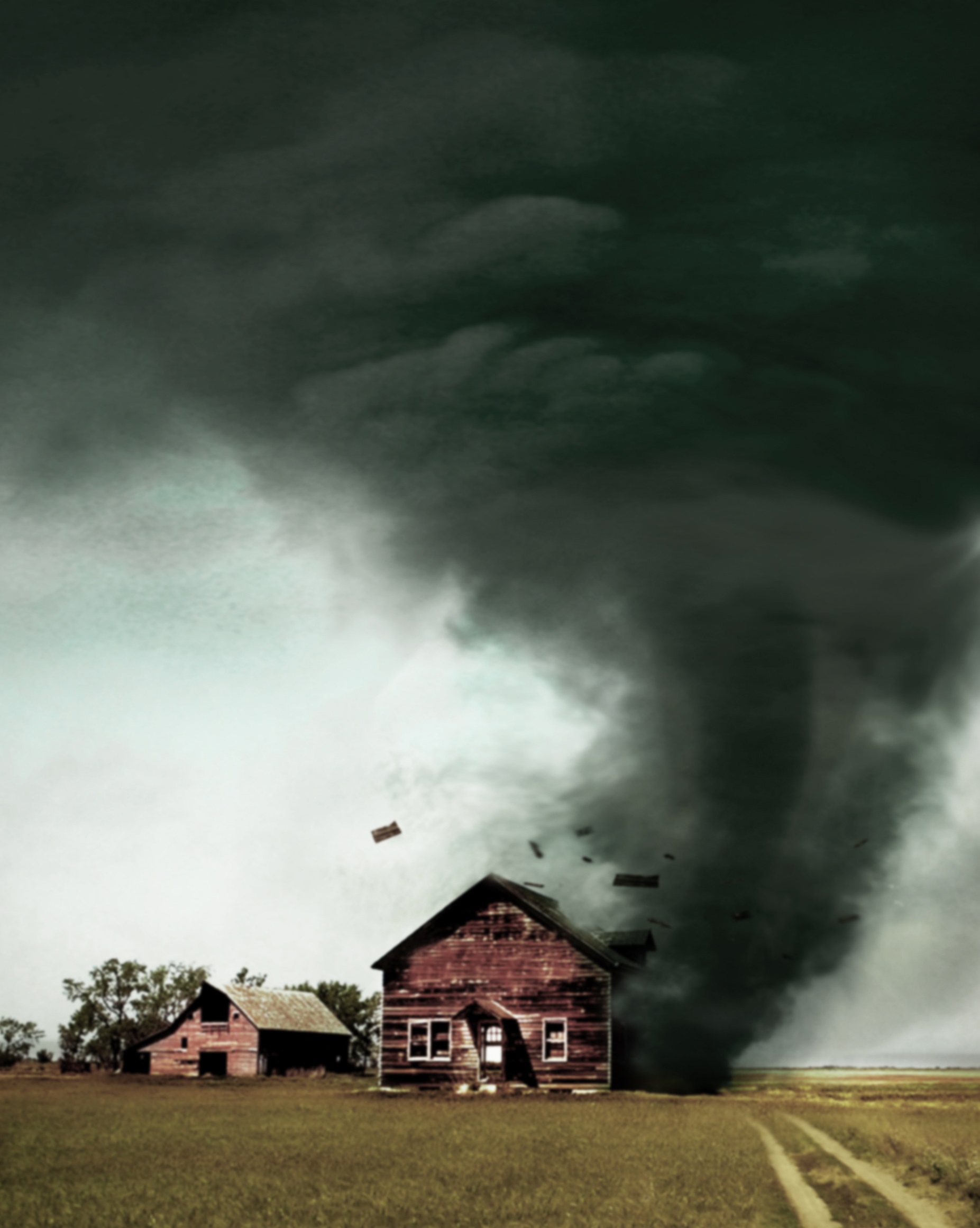
Tornado destroying a house
I probably think too damn much, which is reflected in my dreams, but tortured soul that I am – I rarely have a sound night’s sleep and when I do – what my subconscious mirrors are my worst fears and darkest inner demons…
But they’re not just demons, they’re the lifelong emotions I’ve carried around like a part of my physical person all my life.
I’m talking of mainly the rejection, the loneliness – the things I live with like my living room furniture and the dreams always come back to these two entities…
So, onto the dream… I was just dwelling in my little sanctuary of a home – my home within the city that will ‘never’ be home.
It had become really dark outside in the middle of the day as I stood in the middle of the kitchen.
The rain started to poor outside, but it was mainly the wind.
It quickly took on hurricane strength, as if it had come from right off the sea – rocking my solid little brick house and completely spooking me out, as it howled like an on-coming freight train.
The back door kept flying open as the wind pushed from behind my house and I naively put my all-medal braille machine in front of the back door – thinking it would stop it from flying open.
It was all in vein. I tried locking the door, but then the force of the wind ripped off the entire back wall of my house.
I screamed a long curdling psycho-in-the-shower scream, which resonated through the doorway of my subconscious echoing into the empty chamber of my conscious head, as the menacing black/grey was revealed from the volatile elements attacking. My whole world and sanctuary crashed all around me.
Then it was over, with my scream fading and thankfully, I woke up, in my bed – empty of only the soft purring cat curled next to me under the duvet – I’m still here.