By Dawn M. Sanders
In a nutshell, it sucks! After being here nearly 35 years, I can finally admit, more to myself than anyone, I’m sick and tired of being unhappy, missed opportunities and maybe what could be dubbed ‘drifter syndrome’. Since being here I’ve lived in London, Brighton, Aberystwyth in Wales, rural Derbyshire, Sheffield and now Exeter, just looking for somewhere to call home and welcomes as home.
I won’t go through the full history of how I immigrated here or why, I’ll save that for my autobiography when the time comes, but what I ‘will say’ is I left California, USA, not just because I never fit in there or never felt at home – it was a much more spiritual thing I would later come to understand after being in the UK for 8 years – it was through a shamanic journey, the first of several where I was guided through the experience, where I knew I had been here before and where at least half of my unknown ancestry originated on this side of the pond, in France.
Fast forwarding onto when I actually came here for the second time after only coming the year before on holiday and deciding to return to what felt like home, was I hit with the reality of my young, probably green and ill-thought-out plan to change my life forever.
Then again, I hadn’t gone on the journey until the year 2000 after landing here in ’92. In the first 8 years alone, I had become homeless, got rehoused late in pregnancy with my son, had my son and was raising him as a single mum and had put down my pagan roots in Brighton.
When first coming here on that 6 month work visa, 24 and as green as the English rain-drenched grass, little did I know I would face discrimination I had never faced before.
Little did I know, trying to find a job in a new and unfamiliar, well at least superficially unfamiliar country would mean, facing awkward reactions from people on first sight of me with a visual impairment.
When I got here on that cold January day in 1992 and checked into the YWCA hostel in central London, I was faced with a few spinster type middle-aged women who reacted to me as if I had just dropped in from outer space, rather than the US.
Chinese whispers were everywhere – many of which weren’t whispers at all, but statements of pure ignorance and my visual impairment, what I had lived with all my life, was suddenly like some debilitating curse.
There was a ‘huge issue’ made of me going up and down the stairs, where my room was on the second floor, as if being visually impaired extended to my “ability” to climb stairs and oh yes, it was all about ability and what others perceived was possible.
“That poor girl is in there trying to cook.” I overheard one day when I just made noodles boiled in a pan.
When a taxi driver dropped me off at this nondescript building for a job interview and opened the door to the place he gasped – ”There are loads of stairs.”
Walking down the street carefully learning my new environment I would hear:
“Are you alright?” in that sing-song, downward pointing patronising voice I came to recognise and all too familiar with, as if recoiling upon clapping their eyes on me – had British society never seen a woman with a visual impairment before? Was I supposed to be tucked away behind closed doors somewhere?
I remember in those early days having to seek counselling, because people just couldn’t fucking lay off me – decades later not much has changed as Joe/Jane off the street, on a bus, a crowded café, music gig or any given place out-and-about, I am still likely to get grabbed at, as if I’m moving furniture, not a woman where consent and communication count in the same way as if I wasn’t visually impaired.
What I’ve just described goes much further than how British society reacts to a woman with a visual impairment…
There’s not being able to get a job, due to the sheer level of discrimination, short-sightedness or blinkered mentality I encounter daily.
I remember going for some telesales job where, I got through the office space fine, but the woman there said something like, ‘look I know this is really gonna fuck with you, but Guide Dogs for the Blind (an organisation I wasn’t familiar with at the time, never wanting a guide dog) but they said the place would have been unsuitable for a person with a visual impairment, as the tables and chairs were all over the place.
Well duh, all it would have taken was some rearranging of the furniture to make things more access-friendly, but it was the 90s, I still didn’t know anything of the lack of legislation the UK had in place at that time – I just stupidly thought it would be fair as it was for going for a job in California, where things were made possible and I got respect for what I ‘could do’ rather than be faced with constant barriers of what people presumed I ‘couldn’t do.
I remember walking down a platform with a London Transport worker to get help getting a tube and some girl comes up and says, not to me but to the transport worker: “Who does her makeup?” The poor guy didn’t know what to say, so I said something like: “Why don’t you ask her.” But Brits weren’t used to such forthrightness and people often were shocked at my audacity to speak up for myself – something I learned to do on a daily basis as a cultural consequence of being here.
At the time I hadn’t fully studied or realised the institutionalised oppression.
Looking for a room to rent was no better – I remember getting all the way out to Leytonstone in East London where I was answering an ad, but as soon as I got out of the taxi and was met by the person who was renting out the room I got, ‘um, you’re at the wrong place. I was a bit green, but not stupid enough to believe a lie at the freakout in someone having a woman with a visual impairment turn up – shock horror!
In the States life was never perfect in how I was received being VI, but it was nothing like what I’ve come across in the ensuing years of living here.
Dating or being received as a social/sexual being was pretty much off the menu, as I navigated my way through early motherhood in Brighton. Many of my mates didn’t have kids and only one at the time was also a single mum, but even fleeting boyfriends were extremely rare and, as far as I was concerned, usually socially inept.
Although much of my bad experiences here have been due to my visual impairment, there are of course those little positives that stand out and remind me everything is not all bad.
After dancing through hoops to get some much-needed dental work done and just that first appointment – I finally got something as a one-off through the NHS – that treasured public service privatisation hasn’t completely gulped up, yet.
So, when I walked into the building that was the dental practice – turns out it was an old converted cottage as I asked going up the narrow staircase. I always appreciated the old buildings which adorn this country, steeped in its history.
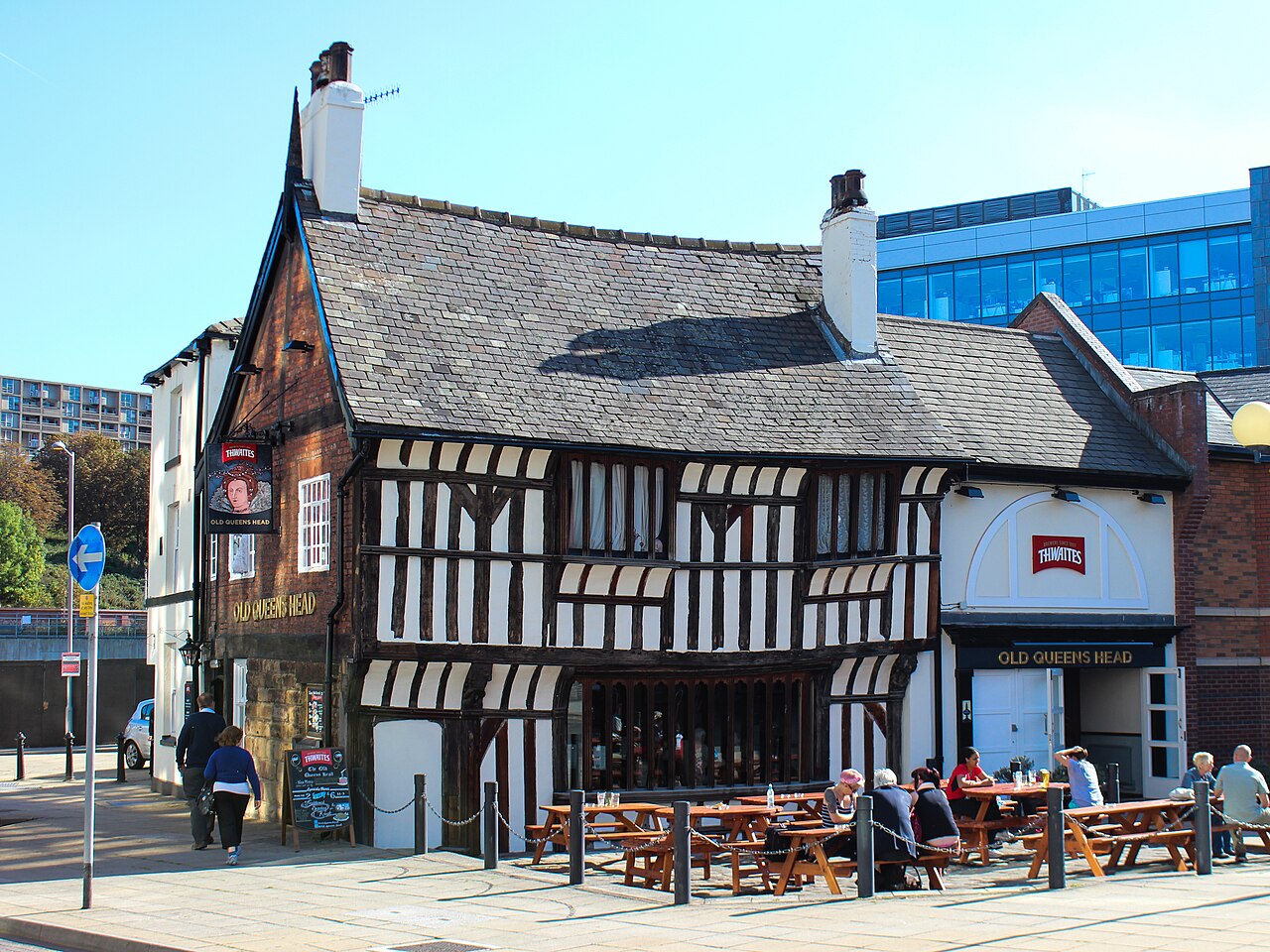
One of my favourite pubs in Sheffield, The Old Queens Head, was built in something like 1476 and where we used to have the Socialist Party meetings in a big dining room upstairs.
Getting introduced to university life surprisingly came with a good mature students’ union and I made some cool connections, but I stood out like a deviant sore thumb and unless they were superficial acquaintances, the marginalisation, the loneliness was ever present – in lecture theatres, sitting alone in pubs while everyone around me sat with friends…. The loneliness is like my shadow – always with me, just more acute when sitting in a crowd – on my own on a beach or anywhere.
I found some kind of solace in political activism, as that first degree was post-9/11 and joining the anti-Iraq campaign meant going on mass demonstrations which, actually started before I left Brighton and set me on something purposeful.
However, even on the UK left, if you have a visible ‘difference’ you’re pigeonholed as “the ‘dis-abled” which I’ll ‘never’ subscribe to as empowering or egalitarian identity language – yet it’s the mainstay in a society steeped in classist division.
In the last year I’ve even started the process of applying for citizenship and reading the Life in the UK, the book you have to read for all the answers to UK citizenship, but the process has hit a barrier and stalled. I started this, not because I particularly have experienced nirvana in this country, but so I can vote and make the difference I want for marginalised people and communities.
After my first degree, where I felt supported, yet stepping out into the real world would of course be fraught with discrimination and labels as, it didn’t matter what qualification one gained academically – the song remained the same.
I threw myself in the years that followed university and leaving Aberystwyth, a small Welsh town full of prejudice and anti-outsider syndrome, into activism, alternative communities where I could find them, because marginalised or off-grid perspectives, for the most part, were more accepting.
That said, when I went with my toddler son in tow, to escape the mainstream pressures with professionals on my son and I like flies, due to his special needs, I still was faced with, ‘um, I’m glad you’re here, but shouldn’t you be asking for a council house?
I already had one back in Brighton at the time, it just seemed to be unheard of, that I would want to jump ship from conventional society for something more meaningful again, always always, because of my visual impairment, it was assumed I needed to be wrapped in cotton wool, safely within the clutches of the conventional rat race, so we spent the first two weeks in the communal tipi at Tipi Valley, at the top of South Wales, before I got us a static caravan someone was selling for a few hundred.
All of this said, life in the UK as I’ve experienced it, hasn’t been all about my visual impairment and people’s reactions, although it has been 90 per cent of it.
There’s experiencing the age-old British class system firsthand when I went to apply for council housing and was met with, ‘You will not get your hands on our housing stock’ a woman at the housing office in Exeter practically shouted at me – even though I was entitled to it and homeless.
My son wasn’t with me at the time, luckily.
Being a single mum just doubled the stigma and has made life like wading through quicksand.
My son and I enjoyed a fairly non-conventional lifestyle in his formative and those colourful years – not something I can say would have ever happened in California, in all its normality and skin-deep lack of culture.
So, why don’t I just go back? Well, it’s not ‘that easy’ for better or worse my life is here, home is here and so is my son.
Meeting him on one of the shamanic journeys, showed me the spiritual and past-life insight that, we had met before and in fact are soul mates.
Had I not come to the UK, met a random stranger in a rough-and-ready biker pub down near the canal in Camden Town, I would have never met my hero, my soul mate and my best friend.
Like with anyone, friends have come and gone, so has the very occasional partner. Of course I could ‘never go back – not with the likes of a modern-day dictator, a psychopath holding the country I once knew as mine to ransom, now as a place I no longer recognise.
Yes, life in the UK is hard, what should be easy and uncomplicated is always made twice as difficult with the imposition of modernity, supposedly advancing technology and a loss of communities.
I felt more treated as an equal when I lived in a staunchly Asian neighbourhood in Sheffield, where people were more working-class, had experienced hardship or discrimination themselves.
I mean, I’ve been at birdcage level and on top of the world – both when I was pregnant and homeless with my son and graduating university for the first time and celebrated on a warm summer’s day on my favourite promenade pub on Aberystwyth Beach, with a few mates at the time, my lad and a short-lived partner.

Life has been dark, several shades of grey, yet as colourful and striking as a dazzling psychedelic chaos lightshow and crazy day at Glastonbury.
When I think of what I left in the States – my estranged family; a good job; my own place and at least a degree of respectability which, was long before I held the two degrees I now have hanging on my wall, not having helped me in the slightest with employment or economic independence. When I think of where I’m at – the stalemate of middle-age, losing myself to the constant concerns of my adult son and his additional needs…
When I reflect as I often do on, ‘would I really have been better off? I guess the answer is – ‘ya win some, ya lose some.
It’s my son who keeps me somehow focused.
He’s all I have for family in the whole country and I’m all he has, so we help each other and communicate in a way few people understand – I would simply never walk away from my hero the Wind Beneath my Wings – even though pushing my 6th decade, I’m really not flying.
© 2026
