By Dawn M. Sanders
Damn this heat wave, as I sit here with my drapes closed to keep my house cool, hiding from the sun.
At the time of writing in May, it’s not even June yet and we’re reeling from the heat. people are seemingly taking it in their stride as, ‘we deserve it after such a long winter’ or are metaphorically shuffling their feet with the extremes of unseasonably cool, wet, and windy to unseasonably baking hot conditions.
Yes, climate change has been normalised and the select contingency seeming to demand action are climate activists or those in the majority world, fighting against western eco-imperialism.
Peripheral circles like Extinction Rebellion or climate change alliance groups who have been forced to retreat from direct, but non-violent action, as the state apparatus has all but criminalised descent against the corporate/ruling class, have made demands via people’s assemblies, but they pale in the face of the status quo, possibly lacking in clear strategy or reaching a diverse cross-section of society.
The Protestival festival, a southwest Extinction Rebellion-staged weekend of workshops, debates, and entertainment and the Eco-Socialism conference took place simultaneously on the last weekend in May.
As debates might have grappled with the climate change, we are living with, while gaping holes are left to fill in with answers or action by collective governments who blatantly could care less about the effects of climate change. Putting capitalist and corporate interests before human life and nature has become the order of the post-industrial world. So, what happened when everyone went home from the events with more knowledge in their heads and good intentions in their hearts against a backdrop of business-as-usual?
Deborah Foulkes, A retired lecturer in languages, journalism and creative writing, based in Germany – dividing her time between Germany and the UK through activism, said:
“It didn’t strike me as being effective – There were no action points to come away with. I have attended other conferences who used breakout rooms more effectively. I don’t think you could take away as much from this conference, it was too much of a broadcast mood, rather than debating effectively.” – having attended the Eco-Socialist conference online.
There’s an ocean of unstoppable traffic outside my front door, as I live on a cut through from a main road to the motorway – the all-prevailing monster motorway…
Every time a plane flies low in the pathway from/to the small airport in my small city, drowning out the constant twittering of the sparrows in my garden, I can’t help but think, ‘is someone just taking a domestic flight up to Scotland? Could they have just as easily gotten on a train to their destination which would be longer but minimally less convenient? Or is it yet another selfish holiday jaunt to the continent, ‘because they can, and someone can afford it – a nifty budget package, where environmental impacts of flying just don’t get a second thought?
It’s difficult not to be up-in-arms when full swathes of the population are seemingly oblivious – where convenience and instant gratification are the ways of the west.
More worrying still, is how the government at all levels, are simply imposing reactionary measures – closing schools, recommending that people stay at home, rather than to ultimately change habits or the way we’ve been programmed to live.
Fast-forwarding to July, as we have a newly installed prime minister – it was horrifying to find out one of Andy Burnham’s key policies is drilling for oil and gas in the North Sea.

In late July we had barely any rainfall apart from in certain confined areas.
The Ecologist and others reports statistics of 2,700 heat-related deaths for May and June, from the intense heat. As of the end of July it has risen to 2,877 and at the beginning of August was estimated at 3,000.
People are given superficial tips or resort to quick fixes to manage the heat.
For example, air conditioning which contributes to 3% of worldwide emissions or 7% of electricity use, according to the IEA (International Energy Agency) which, seems like a low contributor in the grand scheme of causes for climate change, but these figures are set to increase with demand from rising temperatures in counter-productive and desperate measures. With governments failing to affectively address climate change, populations are not motivated to demand those in power change their policies or direction.
I spoke to Anthony, a friend of mine the other day and he rightfully pointed out – for every fifty-odd people campaigning on the effects of climate change, there is at least a hundred thousand that simply could care less.
When his young toddler outgrew his bed and he and his partner got a new one, there was nothing wrong with the old one, he says: “The time, money, and logistics of taking it to be reused is more than I have. I could have kept it in the house for a few days for someone to collect it, I could have taken it to a charity shop for it to be given a new lease of life – however the recycling centre was on my route the next day and I wanted it gone. If the world were a more thoughtful and kinder place, I would be happy to take the time and effort required to take it somewhere, so it was less wasteful and beneficial to others. However, years of seeing how little people are willing to do to benefit the environment or other people has made me sour, and I acknowledge that I have become part of the problem.”
This statement and countless examples of buy/throw away culture, illustrates the influence and lack of conscientious responsibility we are encouraged to take and of course how little planning taken by councils ensuring ease of disposing or upcycling, resonates within society.
So, the buy/throw-away culture beats on with an uncompromising pulse…
Deborah said: “In East Germany, everybody was used to saving every little thing, like screws and nails to reuse them. When an older man I knew from over there first went into a DIY store after reunification, he was so overwhelmed by the abundance of everything, he almost wept. I feel something has been lost along with that careful, saving culture And I don’t think I’m alone.”
When asked how grassroots movements could make an impact at government and local level, Deborah said:
“We cannot tackle the planetary emergency at the level of individual choice alone, although that too is important. We need system change, radical system change. Everyday people, ordinary citizens, need to be incorporated into decision-making to bring about that system change at every level, from the grassroots to the global, via instruments like citizens’ assemblies.”
In my wealth of research in the last year, citizen’s assemblies have taken off in some of the most deprived areas, from Hastings up the country, but success is patchy and often dependant on whether local councils support assemblies and the needs of communities.
My experience and research aren’t exhaustive, as it of course varies from assembly to assembly and location – often more urban and diverse areas with better success.
I spoke to Jamie Kelsey Fry, contributing editor for the New Internationalist. Experienced in creating assemblies, he feels sortition (random selection) is an effective way of ensuring a cross-section of the community is represented, with an array of needs and concerns to be addressed in the name of equality and diversity within assemblies.
With Andy Burnham’s rhetoric of putting power in the hands of communities while simultaneously aiming to burn more fossil fuels, I’m personally not hopeful that climate change in its current trajectory can be reversed.
Assemblies like governments themselves have many aspects of modern woes to address – the cost-of-living, social justice, inequality, but it is people ‘taking back power’ from the millionaire elite which is gathering pace. There are simply too few politicians within the circus arena, willing to listen beyond their own agendas.
I recently went to Zack Polansky’s talk (leader of the Green Party) at the Green Gathering festival, where he pointed out the hollowness of hope, as it’s like leading the masses up a hill, then stopping at the top, with no strategy moving forward. He also pointed out; most political parties simply do not place environmental breakdown high enough on their agenda. So, it must be universally agreed – we as ordinary citizens ‘cannot wait’ for governments to save us.
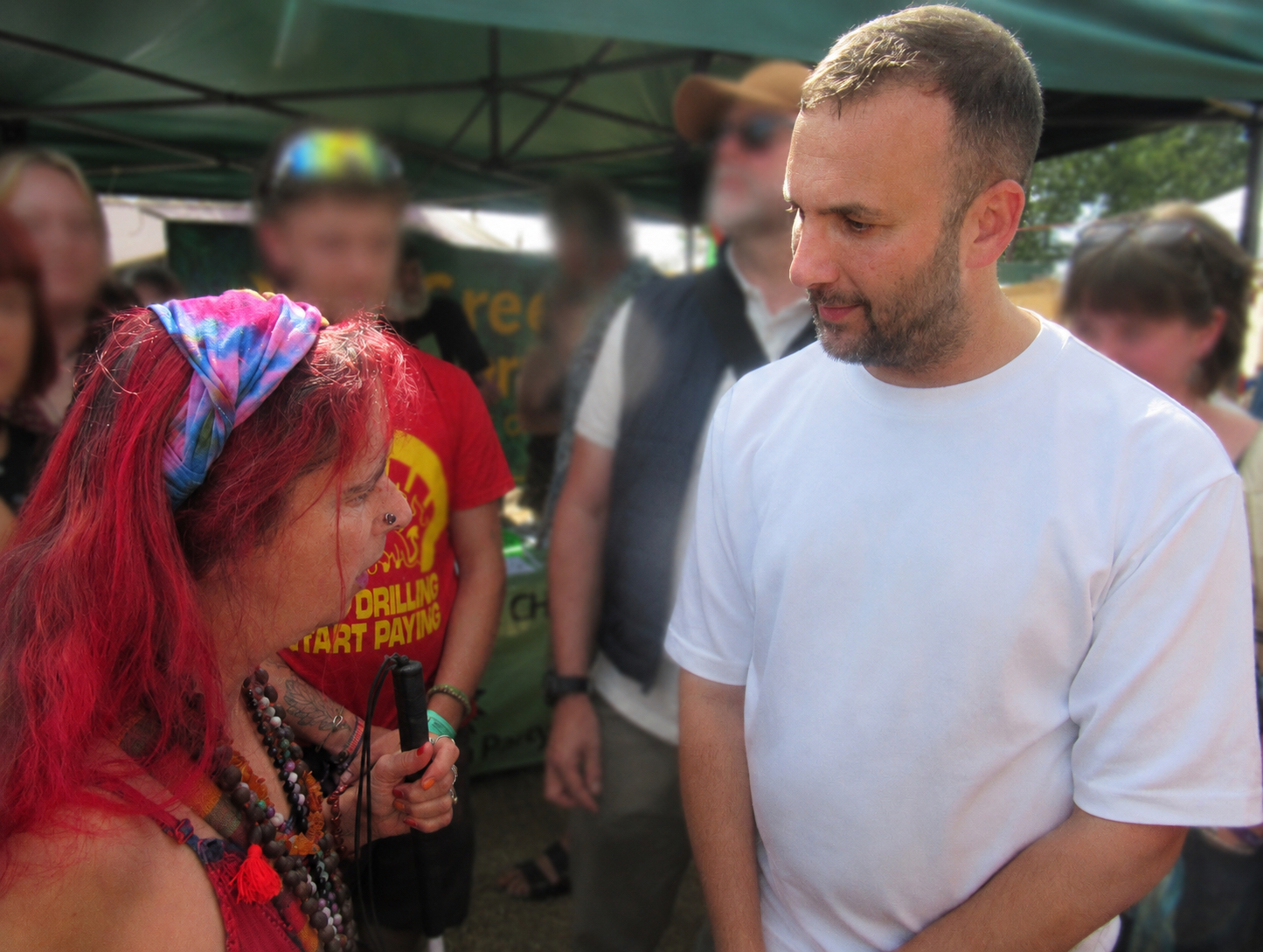
Professor Richard Betts, an environmental scientist who spoke following Polanski, raised the alarm on the world beyond 1.5 degrees – it’s a grim picture.
It’s taken me the better part of the summer to write this piece. With technological setbacks, far too many interruptions and family pressures, I’m glad of the time span and what it illustrates for the season.
On the cusp of the changing season, let father sun retreat gracefully into his autumnal den and then his winter cave.
As the nights creep forth and lady autumn makes her slow, deliberate approach, we, the reckless inhabitants of earth, can welcome the entrance of her golden majesty, her cooling, calming caress – after the perils of extremes caused by human selfishness, lack of insight, with father sun basking us in the consequences.
The land is parched, dehydrated – desperately depleted of hope.
The lush greens which adorned our landscapes are gone.
People are dying, wildfires are raging.
Yet, despite vague manoeuvres behind-closed-doors, reports of the true impacts of the rapid climate change we are seeing, are delayed because they are “too negative” and say what the government doesn’t want to hear?
Where is the backlash; the hand of reprimand putting the brakes on accelerated destruction. Where is the booming voice of humanity calling time on the whole enormous, dangerous game?
We must raise our collective voices in true resistance.
Sixty years ago, during the turbulent times of the ‘60s, society mobilised for change and warning anthems rung out on the destructive path we were placed upon. Generations later, peaceful protest is increasingly handcuffed. The police, judges, and agents of the state infiltrating increasingly crippling laws to silence the masses.
As of 12th August 2026, the UK government held a cobra meeting, but no talk of reversing plans for North Sea drilling, no coherent plan to fundamentally change direction – just a superficial ‘oh, so we will ban barbecues, barely tinkering around the edges… ‘What the hell’ will it take for leaders to change direction and wake up? I would happily stand up in parliament and demand a cross-party acknowledgement of the human and environmental cost taking place before our eyes.
A strong and determined campaign and uncompromising voices raised ‘must start now!
Please sign and share this petition, lets surpass the threshold of 100,000 signatures so it cannot be ignored.
© 2026